
Canadian chicken labelling is regulated by the Canadian Food Inspection Agency (CFIA), but the terms on packages are often misleading. “Grain-fed” means the bird was fed grain (not just grass). “Free-run” means it wasn’t in a cage (but may still be in a barn with thousands of others). “Antibiotic-free” is harder than you think—it requires documenting no antibiotics from day one. Understanding these labels helps you know what you’re actually eating, and why Dixie Lee’s approach to sourcing matters.
Walk into any grocery store, and you’ll see chicken packages with claims printed on them. “Humanely raised.” “Natural.” “No hormones.” “Farm-fresh.” Most of these terms have no legal definition. They’re marketing.
But Canadian regulations do exist. The CFIA sets rules. Chicken Farmers of Canada manages supply. Health Canada oversees imports. Understanding what’s actually regulated versus what’s marketing hype helps you make informed choices.
Freshest ingredients at Dixie Lee start with understanding the sourcing landscape. This guide walks you through what the labels actually mean, which claims matter, and why some restaurants (like ours) commit to humanely raised, non-GMO chicken sourcing even when shortcuts would cost less.
Learn more about Dixie Lee’s commitment to quality sourcing at our Bancroft location or contact us.
The Grain-Fed Label: What It Actually Says
“Grain-fed chicken” sounds natural and wholesome. It’s one of the only labels with actual regulatory backing. But it doesn’t mean what most people think.
Grain-fed in Canadian regulation means the chicken was fed grain (primarily corn and soybean) as its staple diet. It does NOT mean the chicken wasn’t also fed other supplements or medications in the feed, or that the grain was organic. It just means grain was the primary ingredient.
Here’s what grain-fed doesn’t tell you:
| Claim | What It Means | What It Doesn’t Mean |
| Grain-fed | Fed grain diet | Organic grain, or only grain |
| Non-GMO grain | Grain not genetically modified | Non-GMO rest of diet |
| Antibiotic-free | No antibiotics administered | No other medications |
| No hormones | Hormones not added to feed | Chicken’s natural hormones |
| Natural | Minimally processed | Anything specific |
In Canada, chickens aren’t given hormones (that’s a prohibited practice under Health Canada regulations). So “no hormones” on a label is accurate but meaningless—all Canadian chicken has no added hormones.
The real question: where did the grain come from? How was the bird managed? What else was in its diet?
Free-Run Chicken: What It Means (And Doesn’t)
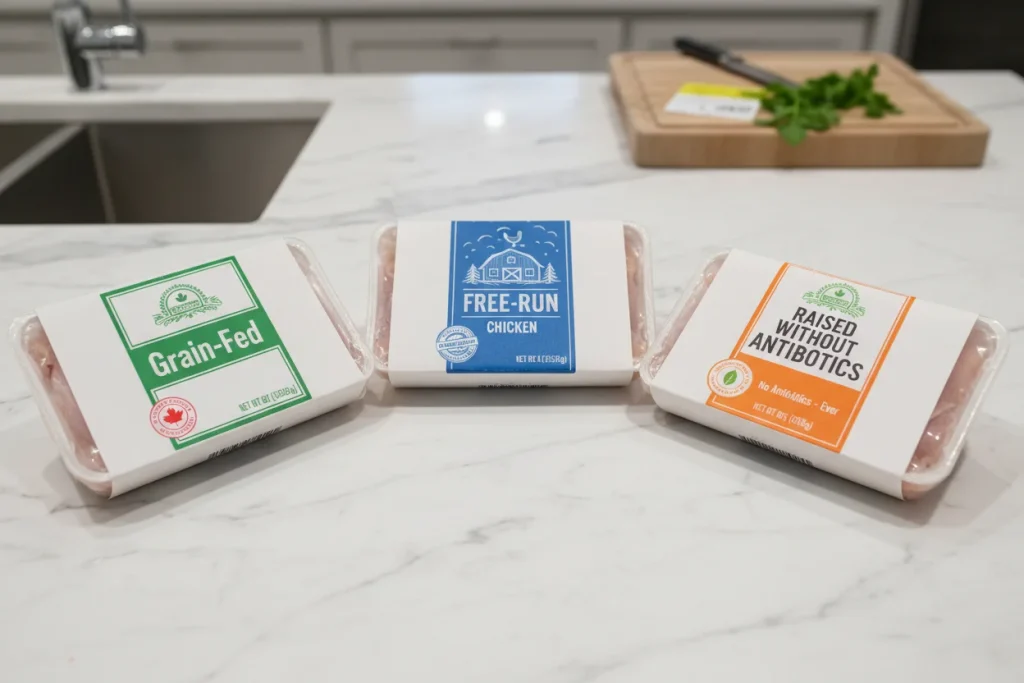
“Free-run” sounds spacious. The bird runs free. Except “free-run” in Canadian regulation just means the chicken isn’t in a cage.
Free-run in Canada means the chicken has access to barn-floor space and nesting areas, but not necessarily to outdoor access. There’s no minimum space requirement per bird. Multiple thousands of birds can be “free-run” in a single barn.
The actual structure:
Free-Run Reality
- Bird not confined to a cage (correct)
- May be in a large barn with thousands of others (also correct)
- Access to nesting box and roosts (required)
- No minimum square footage per bird (surprising, true)
- Usually darker, less ventilation than you’d expect
- Crowding is still possible even without cages
This is not malicious. It’s the system as regulated. If you want more space per bird, you need to look for:
- Pasture-raised (outdoor access, more regulated, more expensive)
- Free-range (outdoor access required, not the same as free-run)
- Direct relationships with farms (the smallest producers, know exactly what you’re getting)
Humanely raised, non-GMO chicken is Dixie Lee’s actual approach: sourcing from producers who go beyond regulatory minimums.
Antibiotic-Free Claims: The Hardest to Verify
Here’s where things get complicated. “Antibiotic-free” sounds simple. The bird was never given antibiotics. But verifying this is much harder than you think.
Antibiotic-free under Canadian regulations means that no therapeutic or growth-promoting antibiotics were administered during the bird’s life. But because chickens are raised in high-density environments, respiratory and infection risks are high. Preventing illness without antibiotics is genuinely harder than the label suggests.
The complexity:
True Antibiotic-Free Production Requires
- Different housing standards (less density, better ventilation)
- Constant monitoring for illness
- Willingness to accept higher mortality rates
- More expensive feed (often organic or specialized)
- Better record-keeping and certification
- Shorter grow-out periods (older birds are sicker birds)
Why Most Chicken Uses Antibiotics
- High-density housing creates infection risk
- Antibiotics prevent illness before it spreads
- Regulatory approval exists for growth promotion (still legal in some antibiotics)
- Lower mortality rates = higher profits
- The record-keeping burden is less
If a label says “antibiotic-free,” that farm chose the harder path. That choice costs money. It shows in sourcing relationships.
| Aspect | Standard Production | Antibiotic-Free |
| Bird density | Higher (profit optimized) | Lower (health optimized) |
| Disease management | Antibiotic prevention | Physical management, nutrition |
| Growth rate | Fast (28–30 days) | Slower (35–40 days) |
| Feed cost | Lower | Higher |
| Mortality | Prevented by antibiotics | Accepted as cost |
| Certification | Standard CFIA | Third-party, verified |
The CFIA Regulation: What’s Actually Enforced
Canada’s chicken supply is regulated more carefully than Americans realize. The Canadian Food Inspection Agency sets standards. Chicken Farmers of Canada manages supply under the quota system. Health Canada reviews all additives.
The CFIA requires regular facility inspections, veterinary oversight, mandatory record-keeping, and traceability from farm to processing. These are actual regulations with teeth, not voluntary guidelines.
What’s regulated:
- Facility standards – Cleanliness, ventilation, water access, lighting
- Health monitoring – Veterinary oversight, disease reporting
- Processing standards – Temperature, sanitation, pathogen testing
- Record-keeping – Feed, medications, and treatments documented
- Traceability – Source farms identified, product tracked
The CFIA’s requirements for food labelling and claims are detailed in their guidance; understanding what the Canadian Food Inspection Agency enforces helps consumers distinguish real commitments from marketing language.
What’s NOT regulated (or loosely regulated):
- Space per bird (minimum standards exist but are generous)
- “Humanely raised” claims (no legal definition)
- “Natural” claims (no legal definition)
- Exact feed ingredients beyond major categories
- Taste or flavor outcomes
The system protects basic food safety. It doesn’t guarantee animal welfare or environmental sustainability. That’s where restaurant sourcing decisions matter.
Why Dixie Lee’s Sourcing Standards Go Beyond Labels
Reading labels is helpful. But labels describe what’s minimum-acceptable, not what’s best.
Dixie Lee sources by relationship, not just regulation. We know our suppliers. We verify their practices. We’re willing to pay more for humanely raised, non-GMO chicken because the owner’s reputation depends on sourcing quality that tastes right. Programs like Chicken Farmers of Canada show what commitment to on-farm standards looks like when farmers go beyond regulatory minimums.
This is the difference between:
- Label-based sourcing (read the package, assume it’s true)
- Relationship-based sourcing (know the farmer, verify practices, taste matters)
When you order proprietary recipe chicken, you’re eating from the second category.
Making Sourcing Decisions: What Actually Matters
If you’re buying chicken at a grocery store, understanding labels helps. But if you’re choosing a restaurant, ask better questions.
Ask restaurants where chicken comes from. Ask if they know the supplier. Ask if they’ve seen the farm. Ask what makes them choose that supplier. The answers tell you whether you’re eating commodity chicken or sourced chicken.
Good sourcing questions:
- Where does your chicken come from? (Specific province/region, not generic “Canada”)
- Do you know the farmer? (Personal relationships indicate commitment)
- What’s your bird’s living standard? (Beyond CFIA minimum?)
- Why did you choose this supplier? (Price, quality, relationship?)
- What makes this chicken different? (If they can’t answer, it’s a commodity)
- Have you visited the farm? (Owners who care usually have)
A restaurant that can answer these questions is making the freshest ingredients a sourcing priority, not just a label claim.
Key Takeaways
- Canadian chicken standards set CFIA minimums, but terms like “grain-fed” and “free-run” often describe a regulatory baseline, not exceptional quality
- Grain-fed chicken means a diet of grain, but reveals nothing about grain type, sourcing, or other feed components
- Free-run chicken means uncaged, but allows thousands of birds in a single barn—not the spacious pastoral image the term suggests
- Antibiotic-free chicken requires choosing the harder production path and usually involves third-party certification
- Humanely raised, non-GMO chicken sourcing is a restaurant choice beyond regulation, indicating relationship-based sourcing, not commodity purchasing
- Support local farmers through restaurants that can answer sourcing questions and know their suppliers by name
Conclusion
Canadian chicken labelling is more regulated than you might think, but regulations set minimum standards, not best practices.
Understanding the difference between “regulation-compliant” and “sourced with care” helps you know what you’re eating. Freshest ingredients at restaurants come from owners who know their suppliers and choose based on quality, not just cost.
That’s why Dixie Lee’s commitment to humanely raised, non-GMO chicken matters. It’s a choice that shows in how the chicken tastes and how the restaurant sources.
When you eat here, you’re eating from someone who asked the right questions and made the harder choice.Ready to taste the difference sourcing makes? Visit the Bancroft location or contact us to learn more about our sourcing.