
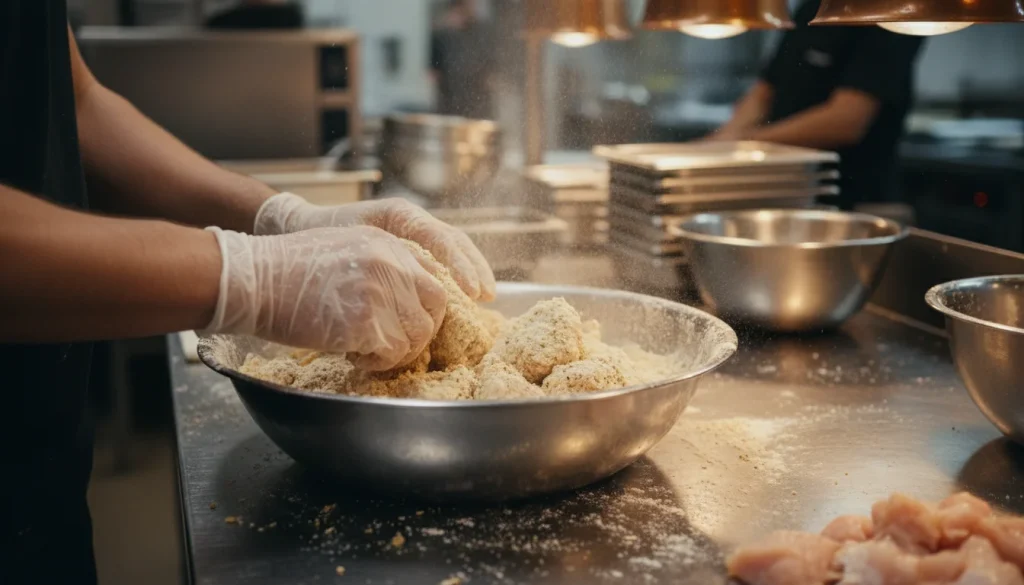
Hand-breaded chicken is coated by hand in seasoned flour at the restaurant, right before it hits the fryer. Pre-breaded chicken arrives frozen from a factory with the coating already applied. The difference shows up in every bite — hand-breaded gives you a crispier crust, juicier meat, and a texture that factory-processed chicken simply can’t replicate.
If you’ve ever wondered why some fried chicken has that satisfying crunch while other pieces taste like cardboard wrapped in grease, the answer usually comes down to one thing: how it was breaded. At Dixie Lee Fried Chicken in Bancroft, every piece is hand-dipped and coated using a proprietary recipe that’s been refined since 1964.
That’s not a marketing line. It’s a kitchen practice that takes more time, more training, and more effort than pulling pre-breaded pieces from a freezer bag. Here’s why it matters to you as a customer — and what to look for the next time you order fried chicken.
What Does Hand-Breaded Actually Mean in a Restaurant Kitchen?
Hand-breaded means each piece of chicken is individually dipped in a wet batter and pressed into seasoned flour by a kitchen worker, then fried immediately. The coating is never pre-applied in a factory, never frozen, and never reheated — it goes from breading station to fryer within minutes.
Most people hear “hand-breaded” and assume it’s just a label. It’s not. The process involves a specific sequence that directly affects the final product. Here’s what actually happens at a hand-breading station:
- Raw chicken is trimmed and portioned to size standards
- Each piece gets dipped in a wet mixture (usually buttermilk-based) for adhesion
- The wet piece is pressed into seasoned flour — the proprietary recipe determines the flavour profile
- Excess flour is shaken off to prevent clumping and ensure even coating
- The breaded piece goes directly into oil held at a precise temperature
The “hand” part matters because humans make judgment calls at every step. Is the coating thick enough? Is the piece fully covered? Does the flour need replenishing? A machine can’t make those calls. A trained cook can.
| Hand-Breaded Process | Pre-Breaded Process |
| Coated at the restaurant, minutes before frying | Coated at a factory, weeks or months before serving |
| Wet batter + seasoned flour applied by hand | Machine-sprayed coating, flash-frozen |
| Irregular texture creates crunch variation | Uniform coating, often thin and fragile |
| Flour blend can be adjusted for freshness | Fixed formula, no on-site adjustment |
| Requires trained kitchen staff | Requires a freezer and a fryer |
The difference isn’t subtle. You can see it, feel it, and taste it.
Why Does Hand-Breading Produce Better Fried Chicken?

The fresh coating creates a thicker, more textured crust that seals in moisture during frying. Pre-breaded coatings are thinner, more uniform, and tend to absorb oil rather than repel it — producing greasier chicken with less crunch.
There’s actual food science behind this. When fresh flour hits hot oil, the moisture in the wet batter creates steam. That steam pushes outward, puffing up the coating and creating tiny air pockets. Those air pockets are what give hand-breaded chicken its signature crunch.
Pre-breaded chicken doesn’t get that reaction. The coating was applied and frozen — the moisture dynamics are completely different. The result? A thinner crust that soaks up oil instead of creating a barrier against it. That’s why pre-breaded chicken often comes out greasy while hand-breaded stays non-greasy with the meat’s natural juices locked inside.
Here’s what else changes when you bread by hand:
- Flavour absorption: Fresh flour absorbs the freshest ingredients and spice blend more effectively than a pre-applied coating that’s been sitting in a freezer
- Texture variation: The irregular coating from hand-pressing creates hills and valleys of crunch — each bite is slightly different, which makes it more satisfying to eat
- Moisture retention: The high-temperature frying process, combined with a fresh coating seals the chicken’s natural fat and juices inside, producing tender chicken cuts that stay moist
- Freshness signal: Your brain recognizes freshly cooked food. The aroma, the steam, the crackle — these sensory cues don’t happen with reheated pre-breaded chicken
| Quality Factor | Hand-Breaded | Pre-Breaded |
| Crunch level | High — thick, textured, varied | Low to medium — thin, uniform |
| Greasiness | Low — coating repels oil | Higher — coating absorbs oil |
| Meat moisture | High — steam seal effect | Lower — moisture lost in freeze/thaw |
| Flavour depth | Rich — fresh spice absorption | Flat — muted by freezing |
| Freshness | Made to order | Made weeks/months prior |
How Dixie Lee’s Proprietary Method Has Worked for 60 Years

Dixie Lee Fried Chicken has used the same hand-breading approach since 1964 — a proprietary recipe developed in Belleville, Ontario, that combines a specific spice blend with custom-made equipment and a frying system designed to consistently produce crispy, juicy fried chicken across every location.
Here’s the thing about proprietary recipes: the word gets thrown around a lot in fast food. But when a method has survived six decades of competition, changing consumer tastes, and franchise expansion across multiple provinces, it’s not just marketing — it’s a system that works.
Dixie Lee’s approach combines three elements that most competitors handle separately:
- The spice blend: A specific ratio of traditional spices that’s been the same foundation since the original Belleville location. The exact formula is proprietary, but the result is a golden crisp coating with balanced seasoning — not too salty, not too bland
- The equipment: Custom-made frying equipment that maintains precise oil temperature throughout the cook. Temperature consistency is what separates good fried chicken from great fried chicken
- The training: Every cook at every location learns the same breading technique. The chicken is hand-dipped the same way in Bancroft as it is at any other Dixie Lee — because the system was built for consistency
The reason this matters to you? Whether you’re ordering at the best premium fried chicken spot in your town or trying Dixie Lee for the first time, you’re getting the same product. Not “similar.” The same. That’s what 60 years of refining a single method produces.
| Dixie Lee Method Element | What It Controls | Why It Matters |
| Proprietary spice blend | Flavour consistency | Same taste across all locations, every visit |
| Custom frying equipment | Oil temperature precision | Even cooking, no raw spots, no overdone pieces |
| Hand-breading training | Coating technique | Consistent crunch and texture per piece |
| Humanely raised, non-GMO chicken sourcing | Ingredient quality | Better base product produces better results |
| Batch timing protocols | Freshness | Never serving chicken that’s been sitting under a heat lamp |
What to Look for When You Order Fried Chicken Anywhere
The easiest way to tell if your chicken was hand-breaded is to look at the coating. Irregular texture with visible ridges and thick spots means hand-breaded. Smooth, uniform, thin coating means pre-breaded from frozen.
You don’t need to ask the kitchen staff to know what you’re getting. The chicken itself tells the story.
Visual Cues
Hand-breaded chicken has a rough, craggy surface. The coating is thicker in some spots and thinner in others because a human applied it — not a machine. Pre-breaded chicken looks uniform, almost polished. The coating is the same thickness everywhere because it was sprayed on in a factory.
Texture Cues
Bite into hand-breaded chicken, and you’ll hear it. The crunch is loud and varied — some bites are crunchier than others because the coating thickness varies. Pre-breaded chicken has a softer bite, more of a crackle than a crunch. If the coating falls off in sheets when you bite, it was pre-breaded.
Taste Cues
Fresh breading absorbs spices differently from frozen breading. Hand-breaded chicken has a more complex flavour because the seasoning is integrated into fresh flour. Pre-breaded chicken often tastes flat or one-dimensional — the spice was locked in months ago and has faded. The best tasting fried chicken you’ve had probably came from a kitchen that breads by hand.
If you’re near Bancroft and want to taste the difference for yourself, Dixie Lee’s been doing this since 1964. But regardless of where you eat, now you know what to look for and why it matters.
Key Takeaways
- Hand-breaded means coated fresh at the restaurant, by hand, right before frying — not pre-coated in a factory and frozen.
- The fresh coating creates steam during frying, which puffs up the crust and locks moisture inside the meat.
- Pre-breaded chicken absorbs more oil during cooking, which is why it often tastes greasier than hand-breaded.
- Dixie Lee has used the same proprietary hand-breading method since 1964, refined over six decades across multiple locations.
- Temperature-controlled frying equipment is just as important as the breading itself — precise heat means consistent results.
- The next time you order fried chicken, ask whether it’s hand-breaded or pre-breaded — the answer tells you a lot about what you’re about to eat.
Conclusion
Hand-breading isn’t a gimmick. It’s a kitchen practice that directly affects the crunch, moisture, flavour, and overall quality of your fried chicken. The difference between fresh-coated and factory-coated chicken is something you can see, hear, and taste — once you know what to look for.
Want to try hand-breaded chicken done right? Find your nearest Dixie Lee location and order online. The tastiest fried chicken in Barrie, Bancroft, Penetanguishene, and Sylvan Lake has been made the same way since 1964 — by hand, every single time.